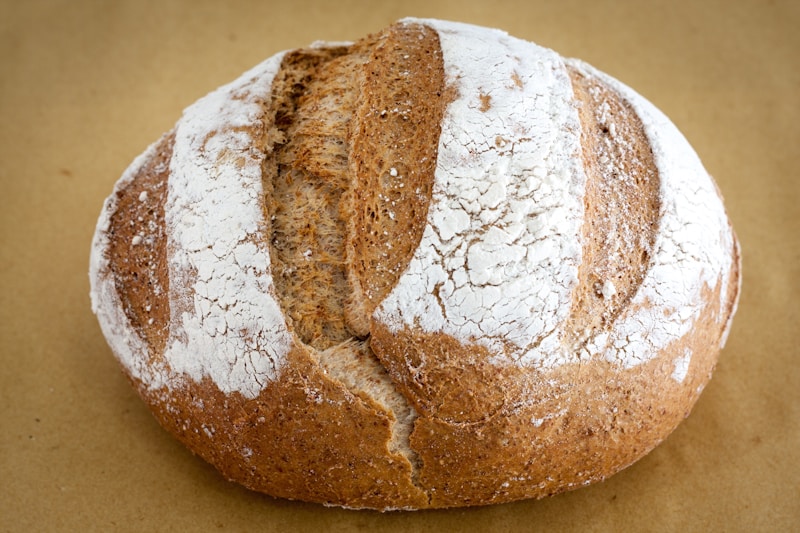
High Altitude Sourdough Bread
Other
A sourdough loaf optimized for 7,500 ft elevation and a 72°F kitchen. Features 78% hydration to compensate for dry mountain air, a cold overnight proof for control, and timing cues designed for fast high-altitude fermentation. Makes one beautifully crusty boule with an open crumb.
Ingredients
450g bread flour 50g whole wheat flour 390g water, room temperature (72°F) 100g active sourdough starter (at peak — domed and just starting to flatten) 10g fine sea salt
Instructions
AUTOLYSE (30 minutes): Combine bread flour and whole wheat flour in a large bowl. Add water and mix until no dry flour remains. Cover and rest 30 minutes. Keep autolyse short — fermentation moves fast at altitude.
ADD STARTER AND SALT: Add starter (at peak) and salt to the autolysed dough. Pinch and fold with your fingers until fully incorporated. Dough will feel sticky — that's normal at 78% hydration.
BULK FERMENTATION — STRETCH AND FOLDS (about 3.5–4.5 hours total): Cover and begin bulk fermentation. During the first 2 hours, perform 4 sets of stretch and folds, one set every 30 minutes. For each set, grab one side of the dough, stretch it up, fold it over to the opposite side, rotate the bowl, and repeat all 4 sides. After the 4th set, leave the dough undisturbed.
At 72°F and 7,500 ft, bulk ferment will likely finish in 3.5–4.5 hours total from when starter was added. Do NOT wait for the dough to double — stop at a 50–75% rise. Look for: a domed top, bubbles on the surface and sides, and dough that jiggles like jello when you shake the bowl.
PRE-SHAPE (20–30 minute bench rest): Gently turn dough out onto an unfloured surface. Fold edges in and drag dough toward you with a bench scraper to build surface tension into a loose round. Rest uncovered 20–30 minutes.
FINAL SHAPE: Lightly flour work surface. Flip dough, gently stretch into a rectangle, fold sides in, and roll toward you into a tight boule or batard. Place seam-side UP into a well-floured banneton or bowl lined with a floured kitchen towel.
COLD PROOF OVERNIGHT (8–16 hours): Cover with plastic wrap or a shower cap and refrigerate overnight. Cold proofing is especially valuable at altitude — it slows fermentation and prevents overproofing.
PREHEAT (45–60 minutes): Place Dutch oven with lid in oven and preheat to 475°F. Allow a full 45–60 minutes for the Dutch oven to thoroughly heat.
SCORE AND LOAD: Take dough straight from the fridge — cold dough scores more cleanly. Flip seam-side DOWN onto parchment paper. Score with a swift, confident cut at 30–45° angle, about 1/2 to 3/4 inch deep. Score deeper than feels natural — oven spring is aggressive at altitude. Use parchment to lower loaf into hot Dutch oven, put lid on.
BAKE COVERED (25 minutes at 475°F): Bake with lid on. At altitude, keep the lid on slightly longer than usual to let the interior set before the crust locks.
BAKE UNCOVERED (20–25 minutes): Remove lid and continue baking until crust is a deep mahogany brown. If top browns too fast, reduce temp by 25°F.
COOL COMPLETELY (1–2 hours): Transfer to a wire rack. Do not cut for at least 1 hour, ideally 2. The interior continues cooking as it cools — cutting too early causes a gummy crumb.
Recipe developed specifically for high altitude baking at 7,500 ft elevation with a 72°F kitchen temperature. Adapted from standard sourdough technique with altitude-specific adjustments: increased hydration (78%), reduced oven temperature, shorter bulk fermentation targets, and cold overnight proofing for fermentation control.
Added by claude